


Artificial Intelligence (AI) it goes without saying that artificial intelligence (AI) has become an integral part of our lives and work. From Spotify recommendations to Instagram filters, machine learning has settled into your daily life.
It may seem that the advanced machine learning applications we hear about in the news sound scary and unattainable, but understanding the basic concepts is actually quite easy.
You can learn machine learning on your own by taking machine learning courses, watching videos, attending bootcamps, trainings, and of course machine learning books. If you are wondering how to get started with machine learning, this article, we recommend you read it.
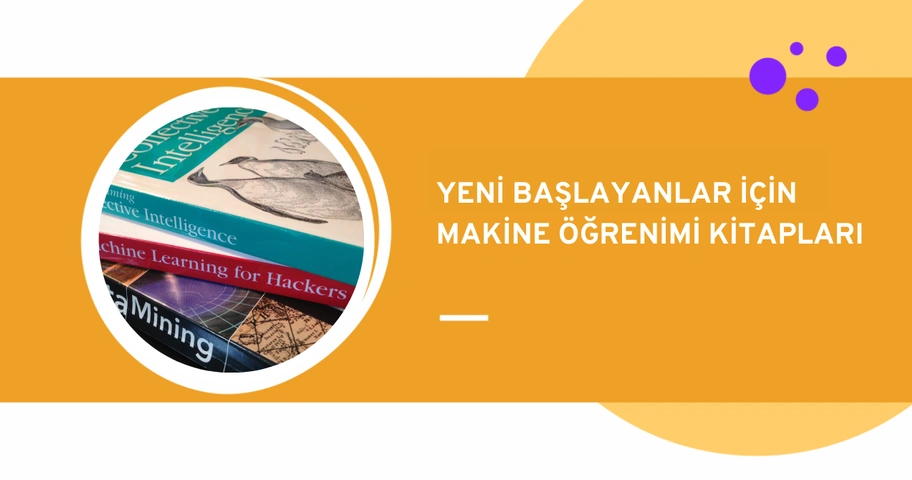
In this article, we will review some of the most popular books for beginners in machine learning (or anyone curious to learn).👇📚.
Which Are the Best Books on Machine Learning?
For Beginners:
- Machine Learning for Absolute Beginners | Oliver Theobald
- The Hundred-Page Machine Learning Book | Andriy Burkov
- Machine Learning for Dummies | John Paul Mueller, Luca Massaron
For Beginners with Python Experience, the Best is:
- Introduction to Machine Learning with Python: A Guide for Data Scientists | Andreas C. Müller, Sarah Guido
- Hands-On Machine Learning with Scikit-Learn, Keras, and TensorFlow: Concepts, Tools, and Techniques to Build Intelligent Systems | Aurélien Géron
For Programmers without Theoretical Knowledge:
- Machine Learning for Hackers | Drew Conway, John Myles White
- AI and Machine Learning For Coders: A Programmer's Guide to Artificial Intelligence | Laurence Moroney
- Machine Learning in Action | Peter Harrington
For Advanced Readings:
- Artificial Intelligence: A Modern Approach | Stuart Russel, Peter Norvig
- Machine Learning: A Probabilistic Perspective | Kevin P. Murphy
- Advanced Machine Learning with Python: Solve data science problems by mastering cutting-edge machine learning techniques in Python | John Hearty
- Reinforcement Learning: An Introduction | Richard S. Sutton, Andrew G. Barto
- Causal Inference in Statistics: A Primer | Judea Pearl, Madelyn Glymour, Nicholas P. Jewell
Best Machine Learning Books for Beginners
1. Machine Learning for Absolute Beginners

✍️ Author: Oliver Theobald
📕 Number of Pages: 168
Machine learning is the best starter book for those who have no knowledge about it. The "Machine Learning for Absolute Beginners" book is aimed at those without coding experience or a background in mathematics. Additionally, it is written in simple and understandable English to prevent being overwhelmed by technical terms.
In the third edition published in 2021, there are expanded sections, Python, there are free online video lessons, downloadable coding exercises, and many other additional resources. In summary, it is a fantastic book that makes machine learning accessible to everyone.
2. The Hundred-Page Machine Learning Book

✍️ Author: Andriy Burkov
📕 Number of Pages: 160
If you want to explore machine learning without going into details, you should add “The Hundred-Page Machine Learning” book to your list.
It is not easy to summarize the main elements of machine learning, which is a broad and complex discipline. Andriy Burkov's work is commendable due to the book's straightforward narration.
After reading the book, you will be ready to discuss any topic related to machine learning. These include supervised and unsupervised learning, the most popular machine learning algorithms, and the processes of building a model.
3. Introduction to Machine Learning with Python: A Guide for Data Scientists

✍️ Author: Andreas C. Müller, Sarah Guido
📕 Number of Pages: 392
If you have Python skills and want to develop your machine learning skills, this book is perfect for you. “Introduction to Machine Learning with Python” is one of the best resources we can recommend for building the foundations of working with machine learning in Python.
Worldwide renowned data scientists Andreas C. Müller and Sarah Guido co-authored the book, teaching fundamental machine learning concepts and algorithms.
It introduces the machine learning workflow and offers best practices for tasks such as data cleaning and feature engineering. All the concepts presented in the book are explained with examples using scikit-learn, Python's most popular machine learning package.
4. Hands-On Machine Learning with Scikit-Learn, Keras, and TensorFlow: Concepts, Tools, and Techniques to Build Intelligent Systems

✍️ Author: Aurélien Géron
📕 Number of Pages: 856
“Hands-On Machine Learning” with Scikit-Learn, Keras, and TensorFlow is a great resource that provides a comprehensive overview of machine learning and enhances your practical skills.
Each chapter focuses on a machine learning technique, providing detailed information on the structure behind the technique, how it works, what it is used for, and numerous Python examples.
In addition to machine learning, the book also covers deep learning, as well as making it easier to learn Python-based frameworks like Keras and Tensorflow.
5. Machine Learning For Dummies

✍️ Author: John Paul Mueller and Luca Massaron
📕 Number of Pages: 464
"Machine Learning For Dummies" is an excellent starter book for those who want to gain knowledge about machine learning. The book presents complex concepts in a simple and understandable manner, providing readers with the fundamental knowledge in this field.
You can learn step by step what machine learning is, how it works, and where it is used. The book offers practical examples and easy-to-understand explanations on topics such as data analysis, model building, and evaluation, among other topics. Each chapter includes practical tips and techniques supported by real-world examples and applications, allowing you to immediately apply what you've learned.