



What is Agile Development?
Agile, or the agile methodology, is a project management and software development approach that promises faster product delivery with relatively fewer headaches. Instead of gathering everything in a plan and managing it all at once, Agile offers us a small and effective method. It is a beneficial approach focused on speed and the product itself from a repetitive and incremental perspective.
What is the Agile Manifesto?
The Agile approach can be described with the framework that constitutes itself. This framework is the Agile Manifesto, so what is this manifesto? This manifesto is shaped by 4 core values and 12 principles that shape it.
- Individuals and interactions over processes and tools
- Working software over comprehensive documentation
- Customer collaboration over contract negotiation
- Responding to change over following a plan
The Agile Manifesto tells us that these are more valuable.
Some of the principles are as follows:
It is based on speed in the market, being open to change at any moment, continuous and demo-based customer interaction, highly motivated face-to-face interaction, and more. In other words, Agile is an approach to achieve the most productivity in the least time, and I think this can easily be concluded from the literal meaning of "agile".

Software Development Processes
To avoid getting involved pointlessly, it might be beneficial to first examine what software development is, what its processes are, how its cycle is interpreted, and what the presence of Agile methodology is in this context.
First, let's focus on the question: what is the software development cycle? It is created with the effort to produce software of the highest value in the shortest possible time. All the phases developed for this targeted effort are called the software development cycle. It consists of 6 defined subheadings;
Planning/Analysis, Design, Coding, Testing, Implementation/Integration and Maintenance.
Planning
Briefly, in the Planning and Analysis phase, one positions themselves on the requirements and focus points of the work. Project managers and those interested in the work play a role in the focus of this phase. Answers are sought to questions such as who are the potential users, how will they use it, what data should be provided as input, and what should the outputs be as a result. As a result, a Requirement Specification document is obtained and serves as a guideline for the later phases of this project.
Design
Briefly, system requirements are designed based on the requested requirements. It helps us in planning the system architecture in terms of software and hardware.
Coding is the main phase where the necessary implementation is done. Subsequently, the developed coding is tested in the Testing phase. In this stage, necessary functional tests, system tests, integration tests, and acceptance tests are performed.
Our project codes, which have passed the necessary testing phases, are deployed in the Implementation phase of our system. Thus, our requested system is developed, and the only remaining is maintenance, which progresses on a problem-based or request-based basis.
Agile's Place in the Software Development Cycle
The Agile methodology defines the process for developing software/applications as aiming to complete the work quickly and fully meet the customer's requests. In this context, the differences between the standard software development cycle can be addressed as follows:
Usage differences In the normal cycle, it progresses efficiently and qualitatively, well-documented for a good product without deviating from its own framework, while Agile aims to achieve quality with an incremental approach.
Phase differences In the normal cycle, phases are clear, development is managed through certain phases in a cycle, while Agile may vary depending on demand, thus is flexible, therefore modelable.
In the normal development cycle, the product supports all kinds of platforms, while Agile can only be supported on incrementally developed segments.
Instead of the above differences, let's talk about the differences that bring Agile methodology to its place;
Because Agile is a speed and product development focused, change-based methodology, it can be applied with significant efficiency only in less comprehensive projects/small applications. Of course, although it can be integrated into all kinds of projects, predicting this solely for a product development focused approach without good documentation, solid task distribution, and department coordination is not very difficult. Although it remains a perfect fit for startups and small scope projects, Agile is a dynamic approach open to all kinds of changes, including critical and last-minute changes, thus likely providing a great advantage. It is suitable and efficient for all projects where change is needed. Agile is grounded in a realistic and flexible approach and can be managed much more easily due to its limited scope.

Implementation of Agile and Scrum
If you wish, let's talk last about how Agile can be implemented. We said Agile is a methodology, so how do we use it?
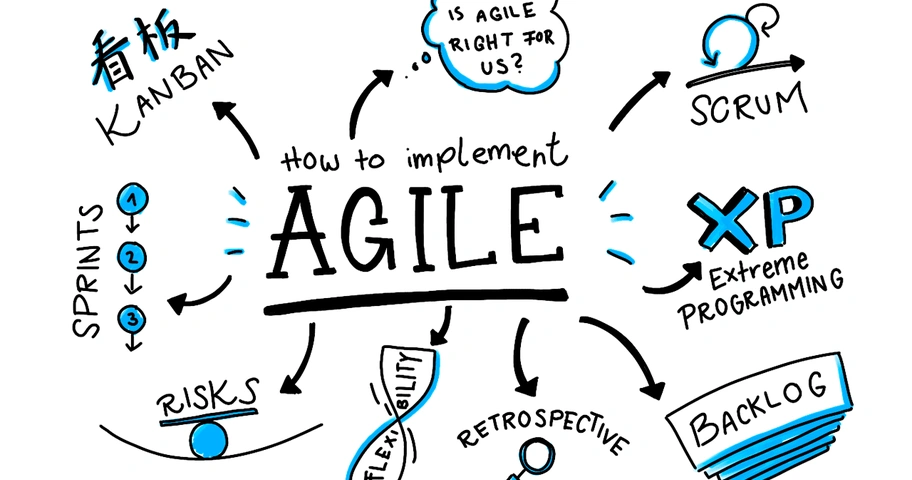
There are different types of project management in Agile; some of them for implementation are: Scrum, Kanban, and others.
I want to talk about Scrum, which is widely used in our article.
In Scrum, there are sprints, these are work periods divided according to the required size. At the end of each sprint, tasks are undertaken and at the end, a product emerges, which has a certain question format. Is there anything missing? What do I need and how do I do it?
- In every sprint, the same cycle is repeated: Planned, Developed, Tested, and Reviewed. According to Scrum's planning, sprint periods can be shaped. In each sprint, a goal is set and the team works as a whole to achieve these goals.
- Every day, a Daily Scrum meeting is held, and it is limited to 15 minutes and briefly plans the next 24 hours.
- There is no task distribution in the developer team, in a Scrum project roles are managed only as Product Owner, Scrum Master and Team Member. A Product Backlog is maintained, which can be said to be a resource where the list of work that should be in the product is listed and attached in priority order.
- Additionally, User Story drafts are maintained, which are kept to empathize with the customer, discussing the roles' needs and the product's responses. Basically, questions like Who wants? What do you want? Why do you want? are answered. For example, sentences in the format "As X user, I want Y so that I can Z".
- Then, the sprint process is ended with a Sprint Review.